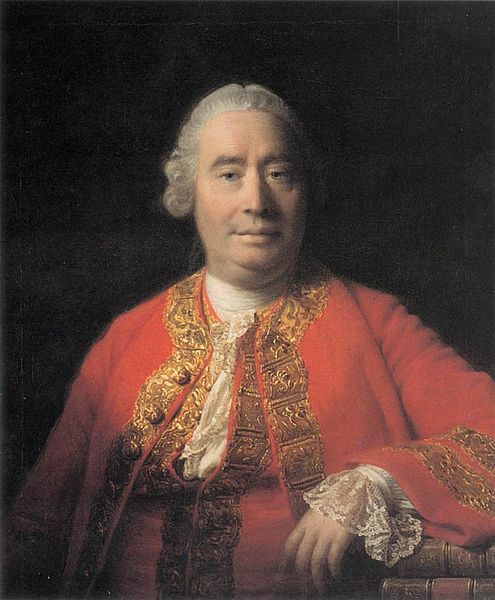
In the reading for Wednesday, Hume compares the data of history ("wars, intrigues, factions, and revolution") with the "collections of experiments" through which "the natural philosopher [i.e., scientist] becomes acquainted with the nature of plants, minerals, and other external objects."
Hume's analogy between the study of history and the study of the natural world depends on several assumptions (which he spells out) about why it's useful to study history.
Identify one or more of those assumptions, then consider it critically. Is Hume's understanding of why history is valuable consistent with why people think history is worth studying now? Is Hume's view of history a product of his time, or is it one of those "constant and universal principles of human nature" that Hume believes characterize people regardless of when or where they live?
Support your claims with some relevant text and be kind and collegial in disagreeing one another.
Deadline: start of class on Wednesday (9/16).


 Posts
Posts


4 comments:
"These records or wars, intrigues, factions, and revolutions, are so many collections of experiments, by which the politician or moral philosopher fixes the principles of his science, in the same manner as the physician or natural philosopher becomes acquainted with the nature of plants, minerals, and other external objects..." (359)
Hume takes a very psychological look at history. History, for Hume, is an account of man's motives and drive behind his actions. He argues that in studying history, we are able to gain greater insight into why the events in history happen. He assumes that events in history act as evidence towards a greater conclusion about man. In the same way that specimens in scientific experiments act as evidence to point to greater theories, the guide of the motives behind human nature acts as "evidence" in the events of history.
To some extent, I agree with Hume. However, I'd like to argue that Hume is very broad and vague in his claims. Sure, there may be deeply rooted issues behind man's motivations to do things. But how can we generalize the thoughts and feelings behind one man's choice in history and attribute it to an entire people group? And how can we assume that just because a man acts in a certain way, he feels a certain way as well. Sometimes what is performed on the outside is not the same as what is thought on the inside. I think that Hume is a bit naive in his thinking.
"Mankind are so much the same, in all times and places that history informs us of nothing new or strange in this particular"(359).
Hume's understanding of history and its value does not go beyond what modern historians practice today. Modern historians study the past in order to foresee the future, because those who know the past of man can ultimately manipulate fate as they see fit. However, by studying past civilizations and their countless mistakes people are more likely to follow the path that they are trying to prevent.
Hume's view of history is not a product of his time or any other time. His belief was merely a realistic observation of the human race. Human nature is and forever will be doomed to repeat the mistakes of the past. The virtues and vices that lie within humans determine whether or not advancement or regression will prosper.
"The general observations treasured up by a course of experience, give us the clue of human nature, and teach us to unravel all intricacies" (360).
I agree with Whitney when she said Hume takes a psychological look at history. This broad statement states that history or past experiences offer a way to learn the details of the past which I believe is somewhat consistent with why we study history today. Observations, past experiences give us details and insight into the past. Yet today we go beyond just knowing details of the past. As Alonzo mentioned history helps us see into the future which I don't think Hume addresses.
He makes general claims which are true and define humanity, manhood on a large scale but he does not address specifics. Therefore his assertions do reflect a "universal principle of nature."
"Should a traveler, returning from a far country, bring us an account of men, wholly different from any with whom we were ever acquainted...entirely divested of avarice, ambition, or revenge...who knew no pleasure but friendship, generosity...we should immediately...detect the falsehood...and prove him a liar." (360)
Here Hume uses his moralistic/historical template as a method for seeking truth or not. The fundamental idea that he is using is that there are innate human qualities, those founded on good/evil or other moral beliefs, is in itself a huge assumption. If indeed humans exhibited these "traits" consistently, Hume immediately clings to these as facts that could differentiate even stories of explorers or travelers who attempt to describe foreign societies. I think comparing this thorough approach to cultures and civilizations is a far different approach to studying history than how it is used now. In the United States especially historical facts and incidents are constantly referred to in light of debate and arguments in attempts to either reinforce or overthrow precendents of historical proceedings; Hume however is using the historical template in order to assign truth or proof in regards to understanding others and a form of education in knowing how "human nature" itself is a very universal idea.
Post a Comment